 Home > About Us > News > Industry News > What Makes a Heavy Duty Truck Air Spring Ready for Real-World Road Conditions?
 Heavy-duty trucks operate under changing loads, uneven road conditions, long driving hours, and continuous suspension movement. In this environment, the air spring is not simply a replacement component. It is part of the suspension system responsible for supporting the vehicle, maintaining ride height, and helping control vibration between the chassis and axle.
For fleet operators, truck parts distributors, repair businesses, and OEM buyers, choosing the right heavy duty truck air spring requires more than matching the appearance of an old component. Dimensions, mounting configuration, working height, load requirements, rubber construction, and vehicle application all need to be considered together.
VKNTECH focuses on the manufacture and research of air springs, shock absorbers, and air compressors, with its product range covering commercial vehicles, passenger cars, trailers, and industrial applications.
Truck loads can change substantially between an unloaded vehicle and one carrying a full payload. A suspension system therefore needs to accommodate changing axle loads while maintaining an appropriate relationship between the chassis and road.
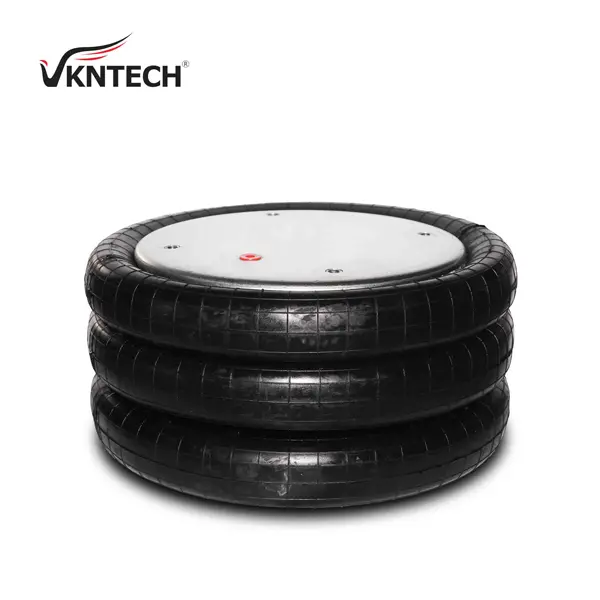
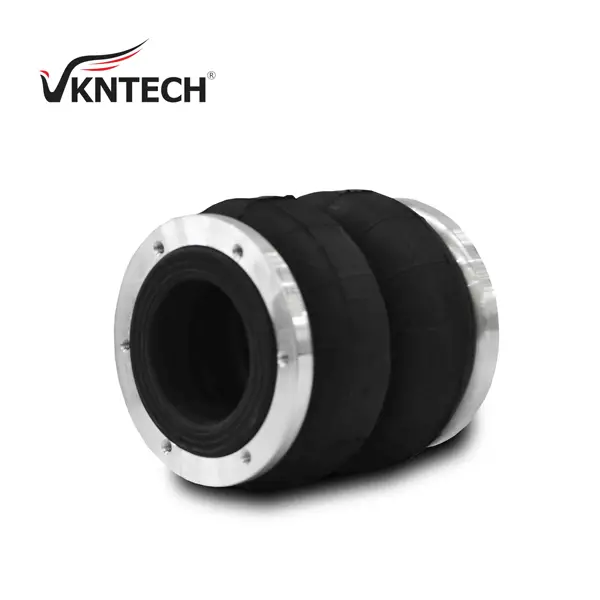
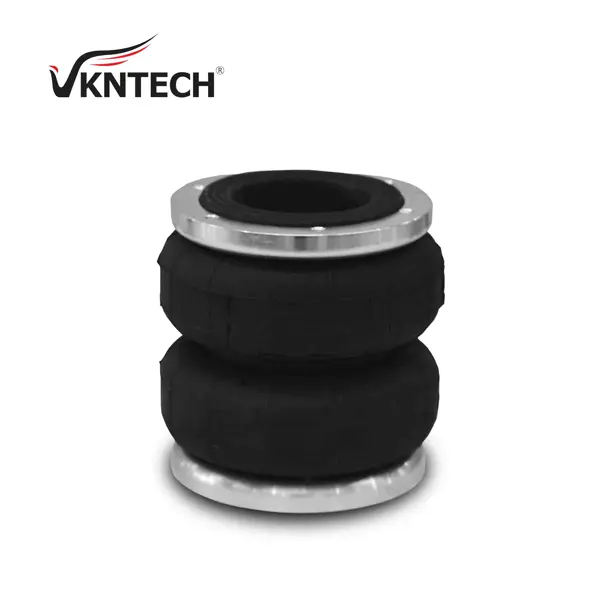
A heavy duty truck air spring uses compressed air within a reinforced flexible bellows to provide the springing function. When combined with a level control system, the air suspension can help maintain a more consistent chassis height as loading conditions change.
According to VKNTECH, air-suspended trucks can maintain chassis height and road clearance regardless of loading weight. The system can also allow vehicle height adjustment for operations such as loading ramps, trailer king pin connections, and swap-body handling.
This makes air spring selection relevant not only to ride comfort but also to suspension geometry and vehicle operation.
When purchasing a heavy duty truck air spring, load support is an important consideration, but it should not be evaluated in isolation.
The air spring has to operate within a specific suspension geometry. Its working height, diameter, mounting arrangement, air pressure range, and available stroke all influence how it functions within the vehicle.
Before ordering a replacement, buyers should verify:
A visually similar air spring may still be unsuitable if one of these dimensions differs from the original specification.
This is particularly important in aftermarket sourcing, where different manufacturers may produce components with similar external designs but different mounting or operating characteristics.
The rubber bellows is one of the most important working parts of an air spring. During normal driving, it repeatedly expands and contracts as the suspension responds to changes in road conditions and vehicle load.
The component therefore needs to withstand repeated deformation while maintaining its air-tight structure.
For a heavy duty truck air spring, buyers should pay attention to the construction of the rubber bellows and reinforcement rather than evaluating only the outside appearance.
Environmental exposure also matters. Truck suspension components can encounter moisture, dust, road debris, temperature changes, and other conditions during normal operation. The appropriate material and construction should therefore be selected according to the vehicle's actual working environment.
Working height has a direct relationship with suspension movement.
If the replacement air spring is too tall, too short, or otherwise outside the intended operating range, the suspension may not work within its designed geometry. Differences in mounting height can also affect the available suspension stroke.
For this reason, identifying a heavy duty truck air spring by diameter alone is not enough.
A reliable replacement process should combine the original part number with dimensional information whenever possible. Technical drawings or physical samples can be especially useful when an older part number is difficult to identify.
VKNTECH publishes OEM and cross-reference information for individual truck air spring products. For example, its 1K4101 air spring is listed for Mercedes-Benz Actros MP2 applications with corresponding references from Contitech, Dunlop, Goodyear, and WABCO.
One of the practical advantages of truck air suspension is its ability to adapt to different loading conditions.
According to VKNTECH, truck axle loads can fluctuate significantly according to payload. Air suspension with level control can help maintain chassis height and road clearance as the load changes.
The suspension system also contributes to a lower natural frequency between empty and loaded conditions. This can help reduce vibration transmitted through the vehicle and provide a more controlled operating environment for the driver and cargo.
However, these benefits depend on the complete suspension system. The air spring must be correctly matched with the vehicle's suspension geometry, pressure requirements, mounting structure, and control system.
When an existing heavy duty truck air spring shows signs of deterioration, replacing it should begin with inspection and identification rather than simply ordering a visually similar part.
Common signs that deserve attention include:
These conditions can provide information about both the air spring and the surrounding suspension system. For example, unusual wear may indicate an installation, alignment, or operating issue that should be investigated before fitting a replacement.
A recent VKNTECH replacement-parts guide also emphasizes checking dimensions, mounting structure, working height, rubber construction, and vehicle application when identifying replacement air suspension components.
For individual repairs, correct identification is essential. For fleet maintenance and distributor sourcing, manufacturing consistency becomes equally important.
A fleet may need the same replacement component repeatedly over an extended period. Differences in dimensions or mounting configuration between batches can complicate installation and inventory management.
VKNTECH states that its manufacturing operation covers 30,000 square meters, with more than 1,500 air spring models and an annual production capacity of more than 20 million units. The company has also supplied OEM customers and aftermarket customers in multiple international markets.
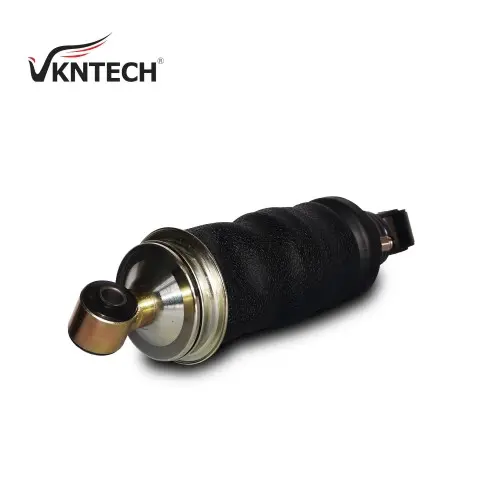
Its truck air spring range includes products for different commercial vehicle applications, while the wider portfolio also covers trailer, bus, cabin, seat, passenger vehicle, and industrial air springs.
A suitable heavy duty truck air spring should be selected according to the actual suspension system rather than by product appearance alone.
Vehicle application, load conditions, working height, mounting dimensions, air inlet configuration, operating environment, and original part references should all be verified before ordering. For replacement applications, combining the original part number with dimensional and vehicle information can reduce compatibility problems.
For OEM and aftermarket buyers, VKNTECH provides commercial air springs alongside other air suspension products and supports product selection for different vehicle and industrial applications.
The practical goal is not simply to find an air spring that fits physically. It is to select a component that matches the suspension's intended working conditions and maintains the required relationship between load support, ride height, and suspension movement.


 en
en
 English
 Vietnamese
 Spanish
 Thai
Thai Portuguese
 Korean
 Russian
 French
 German
 Polish
 Arabic
 Indonesian
 Burmese