 Home > About Us > News > Industry News > Cab Air Spring: How the Right Cabin Suspension Improves Truck Driving Comfort
For heavy-duty truck drivers, long hours on the road often mean continuous exposure to vibration, uneven road surfaces, and repeated impacts. While the vehicle's main suspension system absorbs much of the movement generated by the road, the driver's cabin also needs independent vibration control. This is where a cab air spring plays an important role.
Installed between the truck cabin and chassis, a cabin air spring helps isolate the driver's compartment from road-induced vibration. It supports the cabin, maintains its suspension height, and contributes to a more stable driving environment. For truck manufacturers, fleet operators, repair workshops, and aftermarket distributors, understanding its construction and replacement requirements is essential when selecting the right component.
A cab air spring is an air suspension component designed specifically for the driver's cabin of a commercial vehicle. Unlike a conventional truck suspension air spring, which supports the vehicle axle and chassis load, a cabin air spring works within the independent cabin suspension system.
Its primary function is to separate the cabin from direct vibration transfer from the vehicle frame.
The working principle is based on compressed air contained inside a flexible reinforced rubber bellows. When the truck travels over uneven roads, the cabin moves relative to the chassis. The air inside the spring compresses and expands in response to this movement, helping absorb shocks and reduce vibration transmitted into the cabin.
Depending on the vehicle's suspension design, the truck cabin air suspension system may also include shock absorbers, mounting brackets, height-control components, and other supporting parts.
The air spring and shock absorber have different functions. The air spring supports the cabin and provides elastic suspension, while the shock absorber helps control movement and prevent excessive oscillation.
Together, these components contribute to a more controlled cabin suspension system.
Heavy commercial vehicles operate under demanding conditions. Road irregularities, uneven surfaces, and repeated vehicle movement can generate vibration that affects both the chassis and the driver's compartment.
An independent cabin suspension system helps address these conditions.
A properly matched cab suspension air spring helps isolate the cabin from vibration generated by the chassis. This can reduce the amount of road disturbance transmitted to the driver's seat, dashboard, and other cabin components.
For drivers covering long distances, reducing unnecessary vibration is an important part of improving the working environment.
The air spring provides elastic support between the cabin and chassis. Its internal air pressure and mechanical characteristics influence the cabin's working height and movement.
When the component operates correctly, it helps maintain the intended suspension characteristics under normal driving conditions.
Unlike a conventional fixed-rate metal spring, an air spring uses compressed air to provide load-dependent spring characteristics.
This allows the cabin suspension system to respond to changing operating conditions. The actual performance depends on the spring design, air pressure, mounting arrangement, and vehicle suspension configuration.
Understanding the structure of a cab air spring helps buyers evaluate product quality and identify possible causes of failure.
Although construction varies between models, common components include:
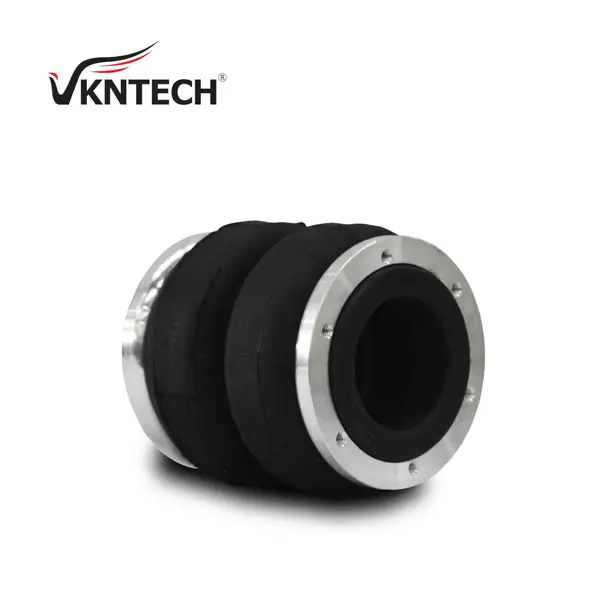
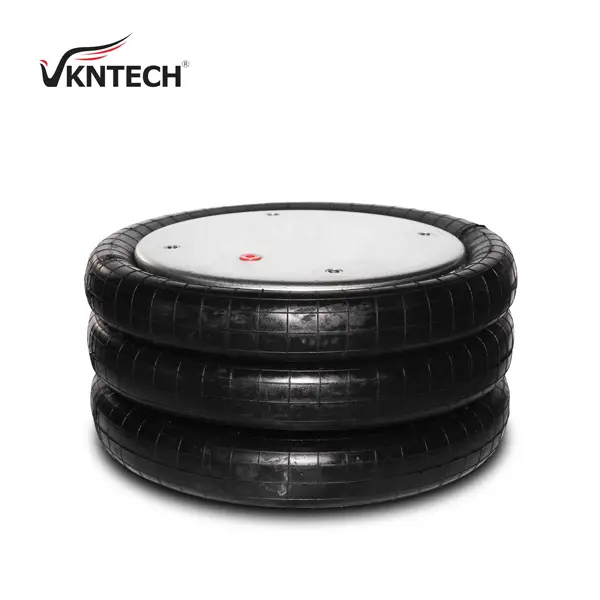
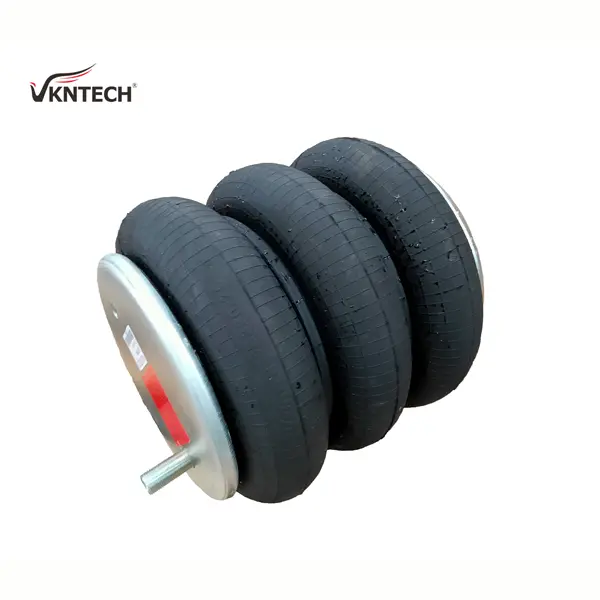
Reinforced rubber bellows: The flexible bellows contain compressed air and provide the primary elastic suspension function. Reinforcement layers help the rubber structure withstand repeated deformation during operation.
Metal mounting plates: These components provide the mechanical connection between the air spring and the vehicle's cabin suspension structure.
Air connection: The air inlet allows compressed air to enter and leave the spring according to the requirements of the suspension system.
Supporting structure: Depending on the product design, additional components may be used to maintain positioning and provide the required installation interface.
The quality of these components, together with manufacturing consistency, affects the product's ability to withstand repeated operating cycles.
Selecting a replacement cab air spring based only on its external appearance can lead to installation problems. Different truck models may use different mounting arrangements, dimensions, and air spring specifications.
Before ordering, buyers should check several important details.
Vehicle make and model: Confirm the truck manufacturer, model series, and relevant vehicle configuration.
OE number: Original equipment numbers are among the most useful references for identifying compatible replacement components.
Cross-reference numbers: Some aftermarket products have corresponding references from different manufacturers. These numbers can help buyers identify alternative replacement options.
Installation position: Determine whether the component is designed for the front or rear cabin suspension position.
Dimensions and mounting configuration: Check the overall dimensions, mounting points, and air connection arrangement against the original component.
For example, VKNTECH offers the 1S2919 cabin air spring for Mercedes-Benz Actros 1831–1860 front applications. Its listed OEM references include 9428902919 and A9428902919, with Sachs reference 105392.
Another product is the VKNTECH 1S7206, designed for Freightliner applications. Its listed cross-references include Firestone W02-358-7206, Goodyear 1S5-176, and Freightliner 18-29919-000.
These examples demonstrate why checking identification numbers is important when sourcing replacement cab air springs for different commercial vehicle platforms.
A truck cabin air spring operates through repeated compression and expansion. Over time, rubber fatigue, environmental exposure, and installation conditions can influence its service life.
Several factors deserve attention.
Rubber material quality: The bellows must withstand repeated deformation and the operating temperature range specified for the product.
Operating pressure: Incorrect pressure can affect the working height and suspension characteristics.
Installation alignment: Improper mounting may create uneven loading and additional stress on the rubber bellows.
Environmental exposure: Oil, road contaminants, moisture, and temperature changes may affect rubber components.
System condition: Damaged air lines, leaking connections, or malfunctioning suspension components can affect air spring operation.
Common warning signs include visible cracks, air leakage, abnormal cabin height, and excessive cabin movement. When these symptoms appear, the air spring and related suspension components should be inspected rather than assuming that the rubber bellows are the only source of the problem.
For distributors, repair businesses, and commercial vehicle parts wholesalers, choosing a cab air spring manufacturer involves evaluating more than product availability.
Manufacturing consistency, material selection, product identification, and testing procedures are all important.
VKNTECH, operated by Guangzhou Viking Auto Parts Co., Ltd., has focused on the manufacture and research of air springs, shock absorbers, and air compressors since 2009.
The company operates a 30,000-square-meter production facility and offers a range of commercial vehicle suspension products, including truck air springs, trailer air springs, cabin air springs, and seat air springs.
Its cabin air spring products include models with documented technical testing parameters. For example, the 1S2919 and 1S7206 models list fatigue testing of at least 3 million cycles. Their respective listed bursting pressure values are at least 2.3 MPa and 2.0 MPa.
These figures apply to the individual models and should not be generalized to the entire product range.
VKNTECH also provides OEM and cross-reference information to help customers identify suitable replacement components for different vehicle applications.
A cab air spring is an important component of a commercial vehicle's independent cabin suspension system. By supporting the cabin and reducing vibration transfer from the chassis, it contributes to driving comfort and more controlled cabin movement.
For replacement purchasing, accurate vehicle information, OE numbers, installation position, and product specifications should always be checked before ordering. Choosing a compatible component is essential for maintaining the intended suspension performance.
With its range of commercial vehicle air springs, product-specific technical information, and experience in air suspension manufacturing, VKNTECH provides cabin suspension solutions for truck replacement parts distributors, repair businesses, and aftermarket buyers.


 en
 English
 Vietnamese
 Spanish
 Thai
 Portuguese
 Korean
 Russian
 French
 German
 Polish
 Arabic
 Indonesian
 Burmese