 Home > About Us > News > Industry News > Beyond Ride Comfort: How to Choose the Right Air Suspension for Trailers
 For commercial trailers, suspension performance affects more than how smoothly a vehicle travels. It also influences cargo protection, chassis height, tire contact with the road, and the operating conditions of the axle system. Selecting the right air suspension for trailers requires an understanding of load requirements, suspension geometry, operating conditions, and replacement-part compatibility.
For fleet operators, trailer manufacturers, maintenance teams, and aftermarket distributors, these factors are essential when specifying or sourcing air suspension components. VKNTECH, a brand of Guangzhou Viking Auto Parts Co., Ltd., focuses on air springs, shock absorbers, and air compressors, with products serving commercial vehicle and trailer applications.
A trailer air suspension system uses compressed air within flexible air springs to support the vehicle load and accommodate suspension movement. The air springs work alongside other suspension components to manage movement between the trailer chassis and axle assembly.
Depending on the system design, air suspension can help maintain a more consistent chassis height as the load changes. This is particularly useful for trailers that operate under different loading conditions throughout their working cycles.
Compared with conventional steel spring arrangements, a properly designed air suspension system can provide a lower natural frequency and help reduce vibration transmitted through the chassis. These characteristics can benefit cargo protection and ride quality, although actual performance depends on the complete suspension design, load distribution, damping, and road conditions.
An air suspension for trailers is therefore not simply an air bag installed beneath a chassis. It is part of a coordinated system in which air springs, shock absorbers, valves, controls, and mechanical mounting components perform different functions.
Trailers frequently encounter changing loads, uneven road surfaces, repeated suspension movement, and long operating hours. These conditions make the selection of suitable air springs important for both vehicle performance and maintenance planning.
A trailer may travel fully loaded on one journey and return with a lighter load. Air suspension systems equipped with the appropriate height-control arrangement can adjust air pressure to help maintain the intended ride height within the system's operating limits.
This helps the suspension accommodate changing loads without relying solely on the fixed spring characteristics of a conventional metal spring. However, air suspension does not increase the trailer's legal payload capacity. Axle ratings, chassis strength, tire capacity, and applicable regulations still determine the permissible load.
Road vibration can pass through the wheels, axles, suspension, and chassis before reaching the cargo area. A correctly specified air suspension for trailers can help reduce the transmission of certain vibrations by providing an appropriate springing characteristic.
The result depends on factors such as air spring selection, suspension geometry, damping, load, and road conditions. Cargo type also matters: fragile or vibration-sensitive goods may require additional packaging and load-securing measures.
Some multi-axle trailer configurations use a lift axle to reduce tire wear when the vehicle is empty or only partially loaded. In suitable systems, dedicated lifting air springs can raise the axle when the system is designed and configured for that function.
Lift-axle air springs should not be confused with the primary suspension air springs. Their dimensions, working conditions, and mounting requirements may differ, so the correct component must be identified from the suspension configuration and applicable reference numbers.
Choosing a replacement or specifying a new suspension component involves more than comparing product photographs. Several technical details should be checked before an order is confirmed.
The original equipment manufacturer (OEM) number is often the most practical starting point when identifying a trailer air spring. Cross-reference numbers can provide additional guidance when a component is associated with multiple product catalogs or aftermarket applications.
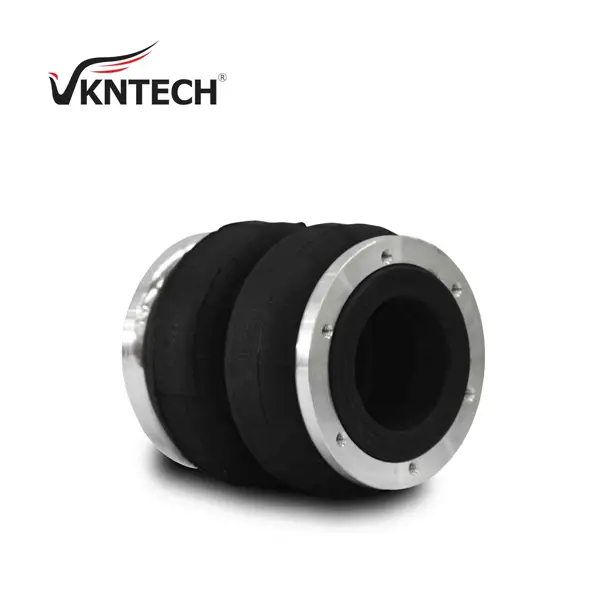
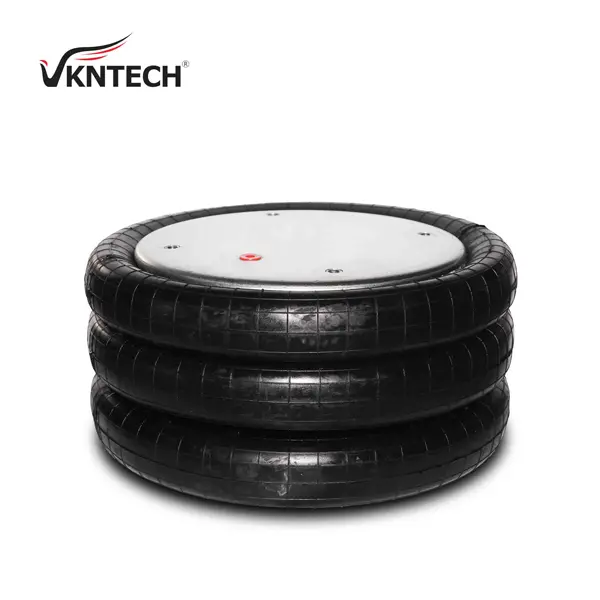
For example, VKNTECH lists trailer air spring models with reference information for suspension applications such as BPW systems. A product may include corresponding references from different air spring manufacturers, helping buyers narrow down potential replacements.
Cross-reference information should still be verified before ordering. A similar-looking component may have a different mounting arrangement or operating specification.
The physical dimensions of an air spring directly affect whether it can be installed correctly. Buyers should check the overall height, bellows diameter, top and bottom mounting arrangements, stud spacing, air inlet position, and piston configuration where applicable.
Working height is especially important because an air spring must operate within its intended range of movement. An incorrect dimension may cause installation difficulties or interfere with the suspension's designed travel.
For distributors and repair workshops, confirming these details before purchasing can reduce incorrect-part orders and unnecessary vehicle downtime.
Trailer air springs are exposed to repeated compression and extension, road debris, moisture, temperature changes, and other environmental factors. The construction must be appropriate for the intended application and operating conditions.
When reviewing product specifications, buyers should examine the stated temperature range, construction details, applicable performance data, and manufacturer recommendations. For example, a listed VKNTECH trailer air spring model specifies an operating temperature range from -45°C to 70°C. This is a model-specific specification and should not be assumed to apply to every product in the range.
The selected component should match the actual operating environment rather than being chosen solely because it belongs to a general trailer air spring category.
Air springs operate under repeated mechanical stress, making regular inspection an important part of trailer maintenance. Several signs may indicate that a component requires closer examination:
Visible cracking, abrasion, bulging, or deformation of the bellows.
Air leakage or difficulty maintaining the intended ride height.
Uneven chassis height that cannot be explained by normal loading conditions.
Unusual suspension movement or changes in ride behavior.
Damage around mounting plates, connections, or nearby suspension components.
These symptoms do not always indicate that the air spring itself is the only problem. Air lines, valves, height-control components, shock absorbers, and mechanical connections may also need inspection.
Before replacing a component, technicians should identify the underlying cause where possible. Installing a new air spring without addressing a damaged connection or another system fault may lead to recurring problems.
For commercial vehicle parts distributors, fleet maintenance providers, and trailer suspension businesses, product identification and manufacturing consistency are important purchasing considerations.
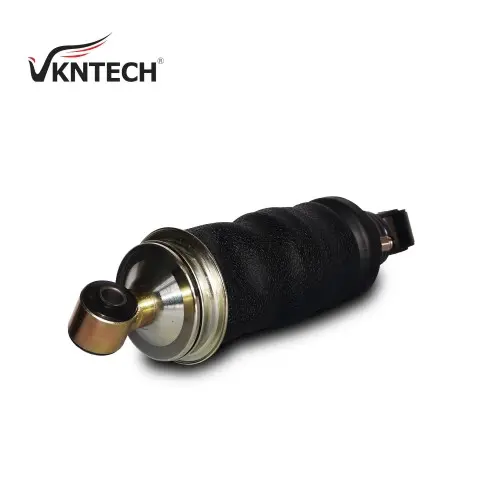
VKNTECH offers dedicated trailer air spring products with model-specific specifications and OEM or cross-reference information. Its product range includes air springs designed for different commercial vehicle and industrial applications, making it important to select products according to their intended use rather than treating all air springs as interchangeable.
Guangzhou Viking Auto Parts Co., Ltd., the company behind VKNTECH, has focused on the manufacture and research of air springs, shock absorbers, and air compressors since 2009. Its published company information also identifies ISO 9001:2015 and IATF 16949:2016 certification. Buyers can use the relevant product documentation to assess whether a particular model meets their technical and sourcing requirements.
When requesting a quotation or checking availability, providing the original part number, cross-reference number, suspension application, and relevant dimensions can make product identification more efficient.
The right air suspension for trailers must match the suspension design, expected loading conditions, mounting dimensions, and operating environment. Load support, vibration control, ride height, and lift-axle operation all depend on selecting components suited to their specific functions.
For replacement-part buyers, checking OEM references and physical specifications before ordering is one of the most effective ways to avoid compatibility problems. For trailer manufacturers and fleet operators, reviewing the complete suspension system helps ensure that the selected air springs work correctly with the associated components.
With application-specific product information and a range of commercial air spring solutions, VKNTECH provides a starting point for buyers evaluating trailer suspension components for maintenance, replacement, and new system requirements.


 en
en
 English
 Vietnamese
 Spanish
 Thai
Thai Portuguese
 Korean
 Russian
 French
 German
 Polish
 Arabic
 Indonesian
 Burmese